
A goth girl wanders around Europe. With purple hair and jacket, pink dress, and choker, Amelia was created as a NPC in an educational video game against “extremism,” Pathways, created by the non-profit Shout Out UK, which created the video game with government support. But she soon broke free from her creators and, thanks to online word of mouth and the possibilities of artificial intelligence, became a sort of spokeswoman for conservatives and sovereignists around the world.
The game was intended to be a propaganda platform against “life choices” (pathways, in fact) considered negative by the current Labour majority: nationalism, rejection of immigration, LGBT issues, etc. In a nutshell, the game led the protagonist, Charlie, to make choices in which wokeist ones won out. Amelia, in the video game, played the part of Lucignolo, the evil advisor, the diabolical suggester of ‘wrong’ choices.
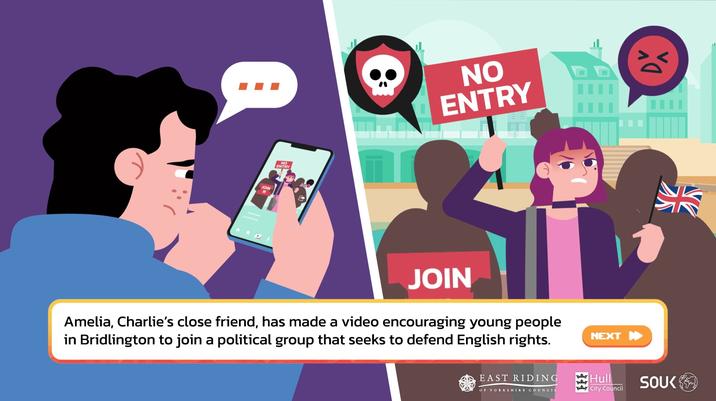
But as the Poet says, ‘if this is good, then we are evil’, and so the ‘bad’ Amelia stepped out of the video game polygons to take on a life of her own. A life in which she continues to do what she did in the game, but to the highest degree. And this time, to the delight of the public.
In the most classic of meme world clichés, some teenager with time to spare and a sense of irony took the character and turned her into a meme. From meme to autonomous versions created with AI, the step was almost instantaneous. And so now we are faced with a phenomenon on the web that is dealing powerful blows to Starmer’s already precarious consensus and already boasts countless attempts at imitation.
Is Amelia’s case that of a simple meme that has gained above-average notoriety thanks to the characteristics that make its protagonist an appealing and viral character? Or, potentially, is Amelia already a new way of doing political communication?
Until a few weeks ago, the first hypothesis was valid, but today we must consider the second. On YouTube, Amelia-themed content, which is still anti-Labour in nature, has millions of views. The most viewed content is a music video, A Million Amelias, from the YouTube channel Skyebrows (a channel with 40,000 subscribers specializing in music videos made with artificial intelligence, combining current affairs with Japanese animation style), which has exceeded 700,000 views. And, not least, the song from the video clip has entered the iTunes Top 100 Dance chart, reaching 5th position.
And if the iTunes chart wasn’t enough to take Amelia seriously as a potential memetic-political force outside the internet, The Hungarian Conservative has taken up the initiative of the British women’s organization Women’s Safety Initiative, which in a recent demonstration to raise awareness of the risks to British women from uncontrolled immigration filled the streets with activists in Amelia cosplay.
Ameliacore, now a meta-musical genre
On YouTube, given the success of Amelia-themed musical content, which constitutes the predominant element of the memetic genre, the existence of a meta-musical genre, Ameliacore, is beginning to be postulated, in which, as anticipated, the political element is always present. The aforementioned most successful video, A Million Amelias, is not the most politically charged Ameliacore content in the genre. That honor goes to Sun All Year Round, a Britpop video clip, also created with AI but characterized by a realistic style, which has reached nearly 300,000 views and in which Amelia praises remigration. It was proposed by one of the new YouTube channels that offer only political content themed around Amelia, Choking Fox.
Although A Million Amelias is not as radical as Sun All Year Round, it is still a direct attack on woke Labour, suffocated by political correctness and woke ideology, well represented by the Starmer government.
A Million Amelias recombines all the themes that made Amelia popular as a spokesperson for conservatives and sovereignists. From simply reclaiming British national pride, made up of both the Empire’s “civilizing mission” and the “little things” of the Englishman of yesteryear: soccer, fish & chips, and pints of beer. There is room to criticize grooming gangs and uncontrolled immigration. The fight for free speech with the inevitable parallels between Labour policies and 1984, as in the famous Macintosh commercial redesigned in deepfake with Starmer\Big Brother and Amelia fighting for freedom
Finally, there are tributes to British classics that are now often considered ‘politically incorrect’ from a woke perspective: Monty Python, Tolkien, Shakespeare, and Harry Potter. Political themes packaged in a lysergic video and a catchy tune that immediately sticks in your head, as demonstrated by its success on iTunes.
Amelia versus the Starmtroopers
Not bad as a mobilizing effect for what just a month ago seemed like a classic meme good for a few laughs but ready to be quickly forgotten. On the contrary, Amelia now risks being one of the contributing factors to Starmer’s resignation.
Because if there is one element in which all the variations of the Ameliacore genre converge, it is precisely the rebellion against the Labour executive. So much so that one of the first viral images of Amelia shows our virtual heroine lighting a cigarette by burning a photograph of Starmer. The same iconography as the ‘supposed’ Iranian activist who went viral a few days earlier during the January riots against the Tehran government (even if in the end she was just a Canadian feminist).
Are the British Labour Party like the ayatollahs? On the other hand, it is a well-established fact that arrests for online comments are higher in the UK than in certain democracies, and the fact-checkers who have come to the rescue of the liberal narrative can only patch things up by protesting that British data is not directly comparable with that of other ‘undemocratic’ countries.
In internet slang, Amelia has become the ‘based goth girl’, the ‘based’ goth girl, i.e. endowed with the values and brazenness that allow her to tell it like it is. The ‘based goth girl’ whose target is the Starmer executive and his ‘henchmen’ known as ‘Starmtroopers’, who, like the Stormtroopers in Star Wars, are as evil as they are cool.
Pathways and Shout Out UK
Amelia was born as a based goth girl in the video game Pathways. Shout Out UK was founded in 2015 with the aim of strengthening democratic values through media and political literacy programs. Among its founders was Italian Matteo Bergamini, who was included in Forbes‘ Top Under 30 – Europe – Social Impact in 2021.
The video game Pathways, in which Amelia appears, was developed in 2023 with the support of several English municipalities but was only released on a large scale at the end of 2025.
Pathways is a graphic adventure game where the protagonist, Charlie, goes through various situations trying not to become ‘radicalized’ according to the philosophy of the Prevent program, which we reported on back in 2023: Do you read Orwell or Tolkien? For Britain, you are a potential terrorist. In short, it is a program whereby any residual element of national pride can be branded as extremism.
After its large-scale release at the end of 2025, Pathways earned the attention of the Telegraph and the Spectator, which intervened to condemn the video game’s paranoid attitude. Any legitimate doubt about the “magnificent and progressive” future of the liberal world would be considered a subversive act.
And trying to ‘radicalize’ the naive Charlie in the video game is our Amelia, who presents herself as a sort of turbo-sovereignist Lucignolo in the interludes that the protagonist has to face.
In the dynamics of the video game, Amelia, conceived by her creators as a negative character, should not be indulged. But in the real world, for anyone with common sense, it is precisely Amelia’s objections to “immigration correctness” that make her the real heroine.
Poppyflowers
From the first articles in the Telegraph and the Spectator, the debate on Pathways should have remained yet another controversy between defenders of free speech and politically correct advocates of thought crimes. But then, in the politically heated climate of British politics, Amelia took over.
To understand how disconnected the creators of the video game Pathways are from the reality of average British sentiment, consider that the game tries to portray veterans and war dead as a negative theme. Among the topics proposed by Amelia to “radicalize” Charlie is the issue of veterans, who, according to the vilaine, are neglected by British governments in favor of “new Britons.” Amelia raises the issue with a comic strip/icon featuring the famous poppy flowers, the poppies of the fields of Flanders, a symbol of the fallen and, by extension, of British veterans. One of the most widespread patriotic symbols in the United Kingdom, they are often worn in the lapel, especially during national holidays.
For the authors of Pathways, the idea was to stigmatize the exploitation of veterans by the radical right.
But the memory of the fallen is a sacred theme for the British public. It was a theme that returned in a devastating way to the British debate at the end of 2025 when one of the last living British veterans of World War II, Alec Penstone, declared on ITV’s morning television program: “The country of today? No, I’m sorry, but the sacrifice wasn’t worth the result that it is now”.
A centenarian veteran who effectively certified the meme that had been circulating for years in the US and UK. Two photos and a caption: above, soldiers engaged on the fronts of World War II (or military cemeteries); below, photos of everyday life today in the US and UK, superimposed with a phrase asking whether it was worth it or a sarcastic and bitter “at least we don’t speak German.”
A true veteran thus certifies coram populo what memes, or what we might call “popular wisdom on the internet,” had been saying for years. And this in the increasingly divisive context of the United Kingdom, where any “patriotic” or traditional element is stigmatized. From the flag with the Cross of St. George being declared “extremist” to rural England being “too white,” from the display of the Union Jack to claiming that the official language of the UK is English.
In this Orwellian landscape, Amelia was the right spokesperson at the right time. She is the real heroine of the game. Much more so than the bland protagonist Charlie or the teacher who reports you to the Prevent protocol if you have attended the demonstrations organized by Amelia.
Within two weeks, Amelia became the epicenter of viral patriotic and anti-Starmer content. On January 25, The Guardian was forced to admit that the far right had a new idol: Meet ‘Amelia’: the AI-generated British schoolgirl who is a far-right social media star.
Subversion or loyalty of the character of Amelia?
The Guardian, in describing Amelia, defines her as a subversion of the character (“subversion of the Amelia character”). The reality is that the only subversion is that of the intentions of the video game’s creators, which have been turned upside down. The character of Amelia outside the video game, the viral Amelia, retains the same characteristics, or rather values, as Amelia inside the video game. The values that are negative in the woke fiction of the video game (and in the excesses of the Prevent program) are still appreciated in the real world by the average person on the street, by the average Charlie.
There has never been a reversal of Amelia’s character. It is not a Praise of Franti à la Umberto Eco, nor is it an operation to re-imagine villains such as those attempted by Disney over the last twenty years, where the ‘villains’ become ‘positive’ protagonists, bad only because of the traumas they have suffered, as in Maleficent or Cruella.
Amelia has always been a positive character
Amelia, in short, has always been a positive character: it takes a lot of woke fanaticism, in fact, to see something rotten in a pretty young girl who suggests patriotic, anti-immigration, and pro-free speech ideas. And the fact that in Pathways (perhaps to respect politically correct “gender quotas”) the role of right-wing activist was assigned not to the classic “bomber jacket and shaved head” but to a girl with a look somewhere between goth and punk, in a product aimed at teenagers, quickly made her go viral. Probably not taking this into account is also the result of the fanatical blindness of the woke front.
Certainly, the fact that the based goth girl could be portrayed in a flirtatious way contributed to the success of the video clip A Million Amelias. But it should be remembered that the song, which openly mocks Starmer, made it into the iTunes charts, where the visual element takes a back seat.
There are two reasons for Amelia’s success compared to other memes that also had political connotations, such as Pepe the Frog or Kekistan. We will now examine them in detail.
Exoteric and esoteric memes
First of all, Amelia is an explicit narrative frame, as intended by her creators. She embodies and dignifies all the demands of those who today oppose the Starmer government and claim the old England.
She is explicit, exoteric, very different from the ‘esoteric’ memes that played a role in Trump’s election victory in 2016, such as Pepe the frog and Kekistan.
Esoteric certainly not because of black magic, nor because of the revelations that call into question the Epstein files relating to the /pol threads of 4chan, which during the 2016 election campaign was the incubator for the ‘Great Meme War’ that gave Trump an unexpected victory against the most powerful mass media war machine ever seen in the history of American elections. The ‘esoteric’ aspect refers to the fact that memes of this kind refer to a communicative language that is allusive to those who already know it, but remains obscure to those outside the context. Only in rare cases does the meme spill over into other social contexts and become viral and then mainstream. The first phase of dissemination, however, requires ‘initiates’ to propose its meanings to the general public.
This is a memetic trend that continues to have a certain visibility, such as Agartha-themed content that is becoming popular in the social sphere of the Alt-Right, but however fashionable it may be, it does not have a meaning that is immediately recognizable to the outside public.
On the contrary, Amelia, the comics in which she stars, her clips, and her songs are always perfectly explanatory in their content, even for those who do not know the character’s origins.
Generative artificial intelligence
The second crucial element for Amelia’s success is that she arrived when generative AI for videos/images/songs was mature and accessible to everyone. AI has made it possible to ride the wave of the character’s virality by offering both realistic content and the now global language of Japanese animation.
The first Ameliacore video to go viral on YouTube was an anime opening, i.e., a video clip made as if it were the opening theme of a hypothetical Japanese cartoon Amelia: the last rose of Albion. The iconography of the video features military cemeteries and poppy flowers. Anime opening-style videos are now a popular genre even on a metapolitical level, so much so that even before Giorgia Meloni’s media exploit in Japan with her ‘manga-style selfie’ and her meeting with cartoonist Tetsuo Hara, Japanese YouTuber 月葉のミッドナイトシーン created several anime-style opening videos at the end of November, shortly after the G20 summit in Johannesburg, on the commonality of ideas and intentions between Sanae Takaichi and Giorgia Meloni. Another meme, like the one about World War II veterans, that anticipates reality.
Monetize or play politics?
A Million Amelias, Amelia: the last rose of Albion, and Sun All Year Round are the most viewed and most structured viral Amelia-themed content on YouTube. Ameliacore playlists feature dozens of videos, often simple variations or reactions to the main and most viral content.
Although lower in category and quality, this content still insists on the same political themes. Namely, criticizing the Labour government of Darth Starmer and his Starmtroopers.
This is limited to YouTube, the platform with the most structured content, but the Amelia wave consists of shorts, comics, and cartoons that are all the rage on other social media. The content is now countless, and even specialized sites such as knowyourmeme struggle to keep track of everything.
Even in other trendy graphic formats, such as comics, Amelia offers more structured content than the average meme. Suffice it to mention the series of comic strips in which Amelia explains how even colonized populations benefited from British colonialism, along the lines of the public works carried out by the Roman occupation in Monty Python’s Life of Brian.
Certainly, Amelia’s success is part of today’s web mechanisms for creating viral content that can be quickly monetized. But it is undeniable that even poor content from the Ameliacore genre, which began as a clone or reaction, is still politicized “viral content.”
It is a way of doing politics that has emerged from the bottom up in an almost open-source ecosystem like Wikipedia. Perhaps the sign that large sections of the population still want politics is that it needs to be a little more ‘grounded’, as demonstrated by the electoral success of Sanae Takaichi, who has found broad support among young Japanese people.
Whether Amelia’s success is pure virality with some political elements, or whether it reflects a desire to engage in politics through catchy songs, what is certain is that politics should know how to ride these waves. The Ameliacore wave is not only more appealing (after all, it is well known that goths sell), but it is also much more structured than many social political contents, which are often limited to the classic “If you are outraged, like this.”
From The Waldo Moment to V for Vendetta
As mentioned, if Starmer were to resign, perhaps Amelia’s hand in it should also be considered. This hypothesis has drawn parallels with one of the most famous episodes of the British dystopian series Black Mirror, The Waldo Moment, from 2013.
Here, Waldo is a CGI animated bear, the protagonist of a television sketch where he comments on current affairs in a populist manner, who is nominated as a candidate in an election. The story is told by Waldo’s voice actor, who is in love with the Labour candidate and increasingly disillusioned with politics and television. In the end, Waldo wins the election, and the final sequence, with the voice actor reduced to begging, suggests that Waldo has become a kind of dictator. But the only thing Amelia has in common with Waldo is that they are both virtual characters. The parallels end there: one comes from above, the other from below.
Amelia’s metapolitical potential could instead be closer to that of the Guy Fawkes mask from the comic book, and later film, V for Vendetta, which becomes a sort of revolutionary archetype against a dystopia conceived in the 1980s as a left-wing critique of the Thatcher governments.
And if, as British activists demonstrate, the purple wig could certainly become a metapolitical trend like V’s mask. But while V’s subversion was an anarchist revolution, Amelia, in her simplicity, is even more disruptive: it is about telling it like it is, and this will cause the system to collapse in on itself. Amelia is the child in “The Emperor’s New Clothes” who says, “But the Emperor has nothing at all on!”.
Moralism and rejection of reality
While Amelia certainly demonstrates the political potential of memes updated to the capabilities of generative AI, it is certainly premature to assess whether this success will carve out a place for her in the long-term collective imagination like the Guy Fawkes masks of V for Vendetta.
But Amelia’s success has nevertheless clearly demonstrated how policies based on moralism and top-down narratives have openly failed. Amelia is successful precisely because in a world of ideological conformity that ignores reality, reality always triumphs in the end.
As Paul Birch notes in The European Conservative:
“In attempting to warn young people away from so-called dangerous narratives, the British government has demonstrated precisely why those narratives flourish; because institutions refuse to engage honestly with public concern, preferring instead to moralise, stigmatise, surveil and, often, arrest. Counter-extremism policy cannot succeed if a nation’s government treats its ordinary citizens as latent threats, or if it prioritises ideological conformity over physical security“.