
Do Numbers Lie?
In a famous trial in California, a well-known lawyer—a staunch opponent of big business and a champion of the rights of citizens “oppressed by large corporations”—began his closing argument before the jury with the words: “This corporation lies; it lies about everything, and it does so by fudging the numbers; it does so by using averages; averages lie!”
Indeed, one must be careful with numbers. When you have a set of numbers that are fairly close together (for example, the set {10, 11, 12, 13, 14, 15, 16}), the average of 13 is representative of the entire set; but when you have highly variable values (for example, the set {20, 21, 22, 23, 24, 25, 500}), you might prefer to use the median of 23, thereby treating the value of 500 as an accidental and non-representative outlier.
Of course, there are statistical methods—even relatively simple ones—that allow us to analyze the entire distribution of a set of numerical data. For example, in this article we analyzed intergenerational economic mobility in the United States by dividing the data into quintiles—that is, five groups each comprising 20% of the total. In short, the numbers don’t lie, but we must be careful of those who manipulate their meaning.
Election Frenzy
The West is in the midst of election frenzy, particularly with regard to the October elections in Israel, the November elections in Spain and the United States, and also those in Brazil in October—Brazil is not part of the West, but the repercussions of a possible new rise of the Right in Latin America could certainly be significant, following the recent victories in Colombia, Chile, Argentina, Bolivia, Costa Rica, Ecuador, Honduras, and Paraguay.
Where do we come from? Who are we? Where are we going?
The vast majority of the Western population goes about its daily life without asking itself, as Paul Gauguin did, “Where do we come from? Who are we? Where are we going?” Numbers can help us understand. Numbers show us that we are living in a unique, exciting, dynamic, and perhaps unrepeatable era. Let’s start with global per capita Gross Domestic Product (GDP), shown below and calculated by John F. Cogan and Kevin Warsh. The authors used estimates of the world’s population, presented here, and estimates of global GDP, presented here, to calculate per capita GDP over the last 2,000 years.

These figures tell us that humanity, with few exceptions, remained in a state of poverty until the 18th century, when Europe began the Industrial Revolution and transformed the world. We are now in the midst of exponential economic growth, with wealth distributed across a broad middle class—a magical moment that should continue for a long time, perhaps indefinitely.
Perhaps by mid-century, thanks to the enormous productivity generated by Artificial Intelligence, we will be able to afford to introduce a global minimum wage and further reduce working hours. Perhaps, by the end of the century, we will have a large community living self-sufficiently on Mars.
From the 18th Century Onward
What has happened since the 18th century? Among many others, there are two main interpretations. The first is that Western culture, based on Judeo-Christian morality and, in particular, on the Protestant and pragmatic ethic of work and success, created the optimal conditions for a series of industrial revolutions, from steam engines to artificial superintelligence (ASI). The second interpretation views the Enlightenment of the 18th century as the flowering of secular and agnostic cultures in Europe, the partial eradication of mystical superstitions and Franciscan virtues of poverty, and the liberation of human thought, which began to focus on the present life and give ample space to the sciences, rather than worrying about the afterlife.
Be that as it may, we are in a period of exponential growth. Africa is still lagging behind, but a reasonable standard of living is bound to arrive there as well. China and India are the two countries leading the charge, with enormous growth rates and a surge that began in the 1970s, as can be seen below.

And what about Europe? And Italy?
Europe is faltering. While before the 2008 recession Europe’s GDP was higher than that of the U.S., today—partly due to Brexit and the pandemic crisis, which was handled very poorly—Europe’s GDP is only 71% of that of the U.S., as illustrated below in a chart from the World Bank.
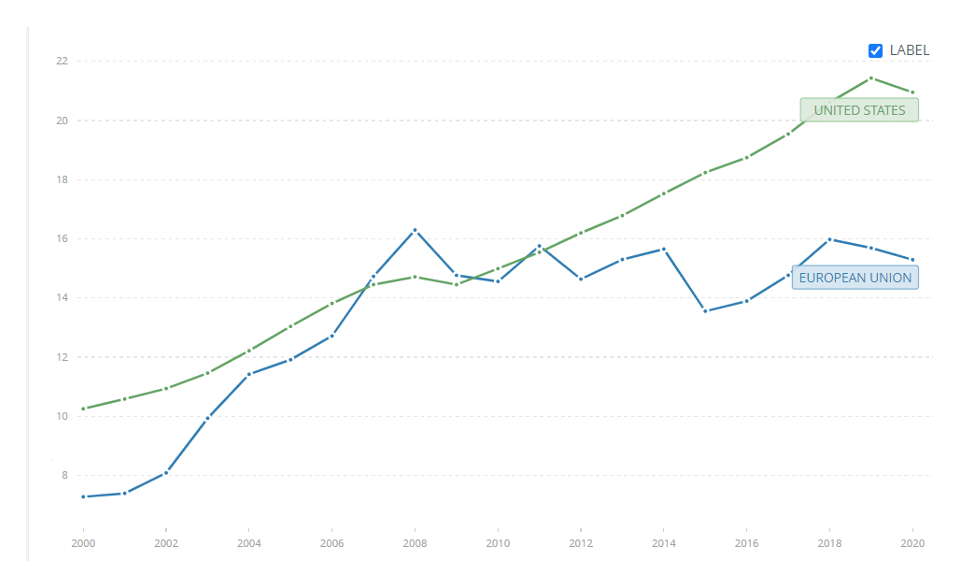
The result is that U.S. GDP per capita today stands at about $93,000—nearly double the EU average of approximately $50,000. But the most important figure—which, coincidentally, tends to be discussed very little—is disposable income, adjusted for taxes, social transfers, and real purchasing power. A summary of disposable income in several countries is presented below. Italy doesn’t fare well!

In short, Italy seems to survive economically only thanks to the willingness of millions of people to work for very low wages—after all, one can always scrape together a little something with some help from family, a small inheritance, and a few under-the-table jobs. It’s not a very pleasant situation, but there are those who are worse off.
It should also be noted that U.S. workers, on average, work many more hours per year (about 1,757 hours) than their European counterparts (for example, about 1,353 hours in Germany).
Let’s Talk About Trump, the Counterrevolutionary
The time has come to talk about U.S. President Donald Trump. Since the end of World War II, there have been three counterrevolutions in the United States: those of Eisenhower, Reagan, and Trump.
The first (1953–61) was that of Republican President Dwight D. Eisenhower, who ended the long string of Democratic victories that began with Franklin D. Roosevelt’s win in 1932, when he implemented the New Deal—a series of quasi- -socialist measures that raised federal tax rates to a peak of 79% in 1935 and 94% in 1944, not to mention the theft carried out in 1933 when the entire population of the United States—individuals, associations, and companies—was ordered to surrender to the government all the gold in their possession—coins, bullion, and gold certificates.
Eisenhower proceeded with great caution, prioritizing economic output over tax cuts. Tax rates remained very high (90%) for the highest income brackets, but optimal conditions were created for the free market, fostering widespread prosperity, high economic output, and low inflation.
The second counter-revolution, following the disasters of President Carter, was that of President Ronald Reagan, who, during the period 1983–88, succeeded in creating economic prosperity, renewing the optimism of the population—which has always been part of the American DNA—and winning the Cold War. Reagan faced much criticism, both political and personal, from European enemies and allies alike, but he knew how to use the carrot and the stick effectively. The stick was used to counter communist revolutionary adventurism in Latin America and to fund the Strategic Defense Initiative (SDI)—nicknamed “Star Wars” by critics and the media—which was a space- and ground-based missile defense system. The carrot was used to encourage trade partnerships and provide aid to allies and potential adversaries. In the end, almost everyone recognized his successes.
The third counter-revolution—that of Donald Trump, the most effective and the most controversial—is still underway and may have to slow down if the Democrats succeed in the upcoming midterm elections in November, as is usually the case in such elections. In Europe, Trump’s second election in November 2024 had sparked a great deal of disappointment and some excitement, although today that initial enthusiasm seems to have cooled.
What are Trump’s numbers?
Inflation, which is a major campaign issue due to rising gasoline and diesel prices, is at nearly normal levels—half of what it was during the Biden era, as shown below:

Unemployment, which had reached high levels during the COVID pandemic hysteria, remains very low:
The U.S. stock market is at all-time highs—a very important fact in a country where a large portion of the population has private pensions invested in stocks. In summary, the most important numbers favor Trump. We’ll soon see, in November, whether voters will be able to interpret them correctly.
A Pessimistic Scenario for Europe
There is a major danger for Europe in a world where
- China and India are more productive than ever;
- Latin America is shaking off the burden of decades of more or less violent Marxism and embracing the free market;
- Africa is beginning to reap the benefits of its low production costs;
- the United States is ceasing—even after Trump—to favor imports without adequate reciprocity and to make gratuitous defense investments in ungrateful allies.
One need not be a MAGA sympathizer to recognize troubling behavior on the part of uncooperative allies or ecclesiastical and judicial hierarchies compromised by terrorism.
Europe seems to have embarked on a dangerous path, marked by contempt for its own roots, deindustrialization caused by climate madness, and mass immigration. It runs the risk of recognizing the consequences of these mistakes only when it is impossible to remedy them.
[Image created with AI]
